
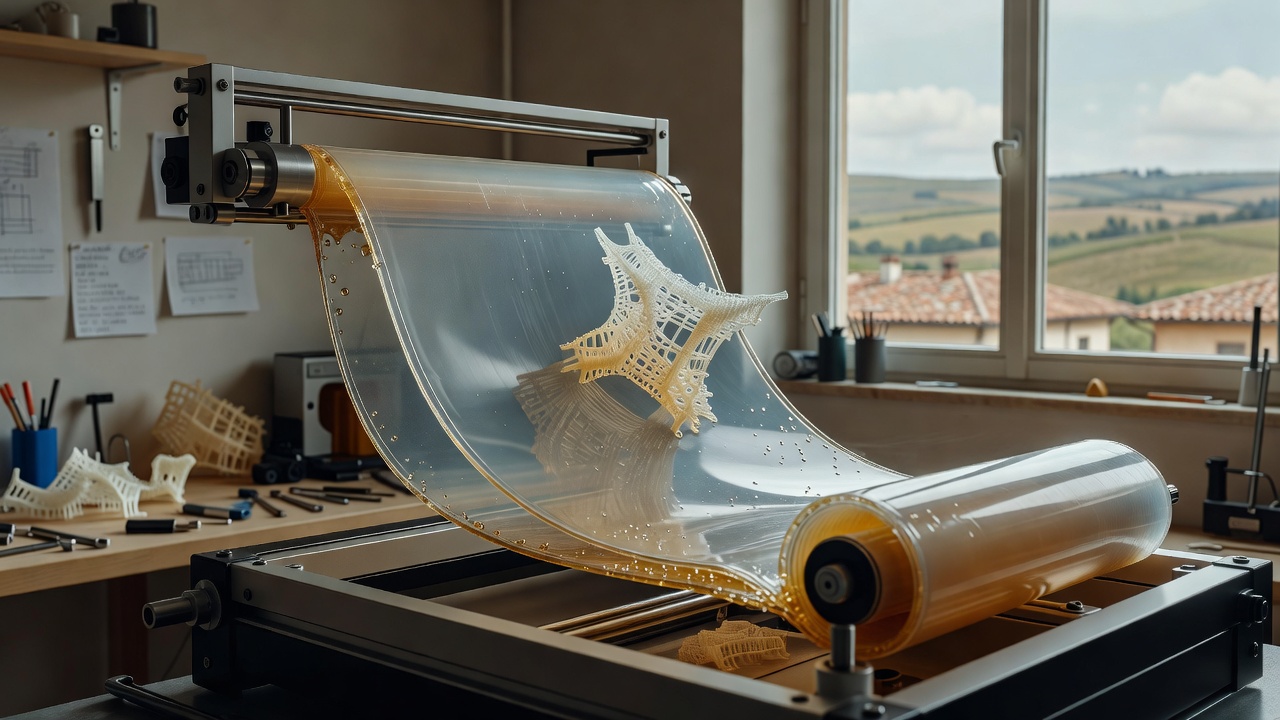
A solo inventor in northern Italy has posted video of a resin 3D printer prototype that replaces the standard resin vat with a moving membrane. The mechanism aims to solve one of resin printing's oldest headaches: the force needed to peel a cured layer away from the build surface.
How the membrane system works
Davide Marin, who operates the sole proprietorship I.D.M. di Marin Davide out of Montebelluna, in Italy's Treviso province, built the device around a transparent membrane coated with a thin film of resin rather than a conventional tank filled with liquid. Each layer is cured against this film, and once curing finishes, the membrane rolls away from the printed object instead of lifting or sliding off it. Marin says the rolling motion, as opposed to the sliding or peeling actions common in many stereolithography and masked-LCD printers, keeps mechanical stress on the part low. He has not released numerical data on peel force, so that claim currently rests on his description rather than independent measurement.
The approach is built for viscous resins, materials that often behave poorly in standard vat-based systems because they resist the pulling and shearing that occurs during conventional separation.
A possible opening for bioprinting, not a proven one
Because the system minimizes sudden separation forces, Marin suggests it could also suit bioprinting applications involving cell-populated scaffolds, delicate structures that are easily damaged when layers are torn apart too abruptly. That potential use remains speculative. Marin presents it as a possibility inherent to the mechanical design, not as something tested on biological material or validated by any outside lab.
He has also outlined variants that are not yet built or demonstrated: versions using projectors or LCD screens for light sources, systems that spray material instead of coating a membrane, and configurations intended for multi-material printing. He describes the eventual goal as "truly fast printing," though no throughput figures, layer times or comparative benchmarks have been published alongside that statement.
What's actually been shown, and what hasn't
The video released October 19 shows one of Marin's first fully functional prototypes, which he says was built in 2023. He has continued developing the system since then but shares newer results only with parties he considers seriously interested in licensing or acquiring the technology. That means the public demonstration reflects a three-year-old stage of the project, not the current state of development.
Marin has filed a patent application covering the mechanism and several design variants, and he describes his effort in modest terms: he calls himself "a small inventor who experiments with many different projects," noting he has worked on this particular concept since 2019 under the name IDM LAB. He also says he has noticed growing industry attention to membrane-based, vatless resin printing generally, suggesting other engineers may be pursuing similar ideas independently.
For potential industrial partners, the offer on the table includes the mechanical design, the pending patent, and seven years of accumulated development experience. Readers should treat the speed and performance claims as unverified until a company brings a commercial version to market with measurable, independently checkable specifications.